
Do You Need a Visa to Enter Jordan? The Answer by Nationality Is Here
Before you book your ticket, you need to know whether you require a visa to enter Jordan and how to obtain it. The good news is that most international patients enter Jordan with complete ease, either directly with their passport or with a visa granted on arrival.
The information on this page is accurate and reliable at the time of writing, but visa regulations are subject to change. It is always advised to confirm the current status with the international coordinator before traveling.
Visa Status for the Most Common Nationalities
Important note: this information is a general reference. Visa policies change. Confirming directly with the international coordinator before traveling is the safest course.
15+ Years
Of Clinical Experience
+6000
Documented Surgeries
1,500
Surgeries in 2025 alone
99%
Success Rate (Lifetime Warranty)
The only surgeon in the Middle East accredited as a Center of Excellence by Wilson, Coloplast, Rigicon, and Boston Scientific combined. His study published in the International Journal of Impotence Research in 2025 proved that he has the highest volume of cases outside the United States.
If You Need a Visa on Arrival: Here Is What Happens
The visa on arrival at Queen Alia International Airport is a direct, quick process that takes only minutes:
Where to go: after you leave the plane and before you reach the baggage claim area, you will find the Visa on Arrival point. Passport officers are there.
What you need: a passport valid for at least 6 months from the date of entry. One personal photo if requested (it is advised to bring one). The visa fee amount (typically modest; confirm the current figure with the coordinator). Your address in Jordan (the hotel name is enough).
Visa duration: the tourism and treatment visa is usually granted for one month, renewable. This is more than enough for the typical treatment stay of 3 to 5 days.
In case of any question: if the passport officer asks about the purpose of your visit, “medical treatment at the Royal Hospital” is a clear, acceptable answer.
What Documents Do You Need to Enter Jordan for Treatment?
In most cases, it is very simple:
The minimum required for most nationalities: a passport valid for at least 6 months. This is usually all you need.
What is advised to bring as a precaution: a document confirming the medical purpose (an appointment message from the hospital, or a WhatsApp thread showing the coordination with the center). This is not usually requested, but it is useful if you are asked.
What you do not need: a special medical permit. Proof of international health insurance. Financial documents specific to the treatment.
Can You Come to Jordan by Land?
Yes. Jordan has land crossings with Saudi Arabia and Iraq, in addition to the Sheikh Hussein crossing and the King Hussein (Allenby) Bridge.
Those coming from Saudi Arabia by land: the Al-Haditha crossing is the most used for those coming from the northwest of Saudi Arabia. The distance from Riyadh by land is very long and not advised for treatment purposes, but from the northwestern parts of Saudi Arabia near the Jordanian border it may be an option.
Those coming from Iraq by land: the Trebil crossing is the main port between Jordan and Iraq. It is used regularly. The distance from Baghdad by land is about 8 to 10 hours, an option some Iraqi patients prefer over flights.
A practical note: air entry from the airport is easier, faster, and more suitable for treatment purposes. The land crossing suits those who prefer it for personal reasons.
Departure: No Exceptional Procedures
Leaving Jordan does not require any medical procedures or special paperwork related to the treatment.
What you need on departure: your passport. Your boarding pass. Arriving at the airport at least two hours before takeoff.
Exit fees: in Jordan there is usually no separate exit fee. Any applicable fee may be folded into the flight ticket price.
Medical documents on departure: you are not asked for any medical document at the passport point. The medical report you carry is for your personal use and for your doctor at home.
If You Have a Companion or More
Each member of your group goes through the same entry procedures independently. There is no group visa or shared procedure.
Practical points: each person carries their own passport. If your spouse is of the same nationality as you, the same entry conditions apply. If she is of a different nationality, check her status independently.
Accompanying children: children who do not hold independent passports need additional confirmation. In most countries, young children are listed on a parent's passport. This is usually accepted, but advance confirmation is advised.
Not Sure of Your Visa Status? We Check For You
The international coordinator at Dr. Hamdan's center can verify your nationality's entry status for Jordan before you travel. Send him:
Your full name as in your passport. Your nationality. Your date of birth. And your expected entry date.
He will give you an accurate confirmation within hours. This service is free and available to everyone planning treatment at the center.
Doubt About Any Detail? One WhatsApp Message Answers You
Visas and procedures should not be an obstacle to your decision. The international coordinator is there to answer any question of this kind quickly and accurately.
International coordinator WhatsApp: +962799198805.
Saturday to Wednesday: 1:30 PM to 5:00 PM. Thursday: 1:00 PM to 3:00 PM. Friday: closed.
Questions That Arise Before Booking the Ticket
Is a medical treatment visa different from a tourism visa?
No. Jordan does not usually issue a separate medical treatment visa. The ordinary tourism visa fully covers medical treatment. The purpose of the visit on the arrival card can be filled in as “medical treatment” or “tourism,” and both are accepted.
How long can I stay in Jordan on the ordinary visa?
The entry visa for most nationalities allows a full month's stay initially, renewable. This is more than enough for the typical treatment stay.
Do I need an official letter from the hospital to get the visa?
Usually no. But if you are of a nationality that needs a prior visa, the coordinator helps you obtain what you need from the hospital.
Is entry with a national ID card accepted?
For some nationalities, regional ID arrangements may apply. But carrying a passport is always advised for any international travel to avoid any issue.
Can I extend my stay in Jordan if I need more recovery time?
Yes. The residence visa can be extended through the Jordanian passport department. The coordinator helps with this procedure if you need it.
What if I lose my passport in Amman?
Your country's embassy in Amman issues a temporary travel document. Jordan allows a traveler to depart with the appropriate emergency documentation from the embassy. The coordinator helps you contact the relevant embassy.
Connect directly with Dr. Mohammad Hamdan now
Start Your Treatment Journey Today
Six specialized services. Internationally certified techniques. Global expert. Absolute confidentiality.
Absolute Confidentiality • Obligation-Free Consultation • Response Within Hours
Frequently Asked Questions
What is the difference between the three implant types?
The malleable implant is firm and simple, suited to less complex cases. The hydraulic implant is inflatable and gives a natural, controllable erection. The dynamic implant is a specialized option for specific cases based on nerve and blood-flow assessment. Dr. Hamdan determines what is right for your case specifically, not the most expensive or the newest.
What is the success rate of penile implant surgery?
99% at Dr. Hamdan's center, based on more than 6,000 documented procedures over 15 years. All implants come with a lifetime warranty from the manufacturer.
How long does the surgery and recovery take?
The procedure itself takes 45 to 60 minutes under local anesthesia. The patient is discharged the next morning. You can return to work within 7 to 10 days, and resume normal married life after 4 to 6 weeks.
Is the surgery suitable for patients with diabetes or heart conditions?
Yes, and it is in fact the ideal solution for these patients who do not respond to medication because of their chronic conditions. Blood sugar must be controlled before surgery (HbA1c below 8.5%) and a cardiac assessment is required if needed.
How long is the implant expected to last?
Modern implants are designed to last 15 to 20 years. The manufacturer's lifetime warranty covers mechanical failure and includes free replacement when needed.
Is the implant visible or noticeable from the outside?
No, the implant is entirely inside the body. There are no external parts. When deflated the penis looks completely natural, and with the Phantom Technique there is not even a visible surgical scar.
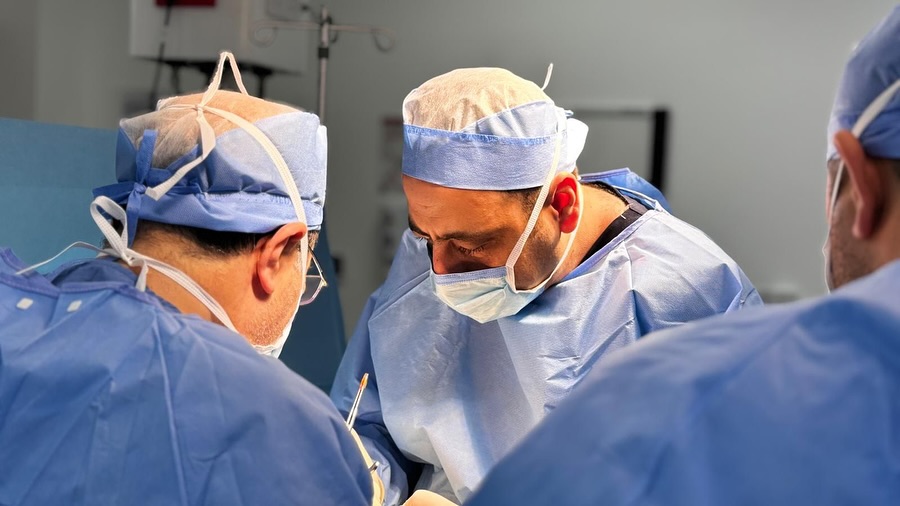
From Dr. Mohammad Hamdan's YouTube channel
Book Your Appointment Now!
Dr. Mohammad Hamdan performs erectile penile implant surgeries in:
Jordan 🇯🇴 | Bahrain 🇧🇭 | France 🇫🇷

Address for Dr. Mohammad Hamdan Clinic
The Royal Hospital, Jordan Street, 3rd Floor, Amman, Capital Governorate 11941

For booking via Call / WhatsApp

Contact via Email

Working Hours
Saturday – Wednesday: 1:30 PM – 5:00 PM
Thursday: 1:00 PM – 3:00 PM

Get in Touch with us
We’re here to help anytime

Call Us

Mail Us

Opening Time
Mon -Sat: 7:00 - 17:00

Dr. Mohammad Hamdan Center for Urology, Infertility, and Andrology. The only center in the region accredited as an international "Center of Excellence."


Contact
Address: The Royal Hospital - Jordan Street - 3rd Floor, Amman, Jordan
Working Hours: Saturday – Wednesday: 1:30 PM – 5:00 PM | Thursday: 1:00 PM – 3:00 PM
Consultations: +962796000995
Confirmed Bookings: +962799198805
All Rights Reserved © 2026 - Dr. Mohammad Hamdan. | Privacy Policy | The information provided on this website is for educational purposes only and does not substitute for a direct medical consultation
Developed By Mash World For Digital Marketing